

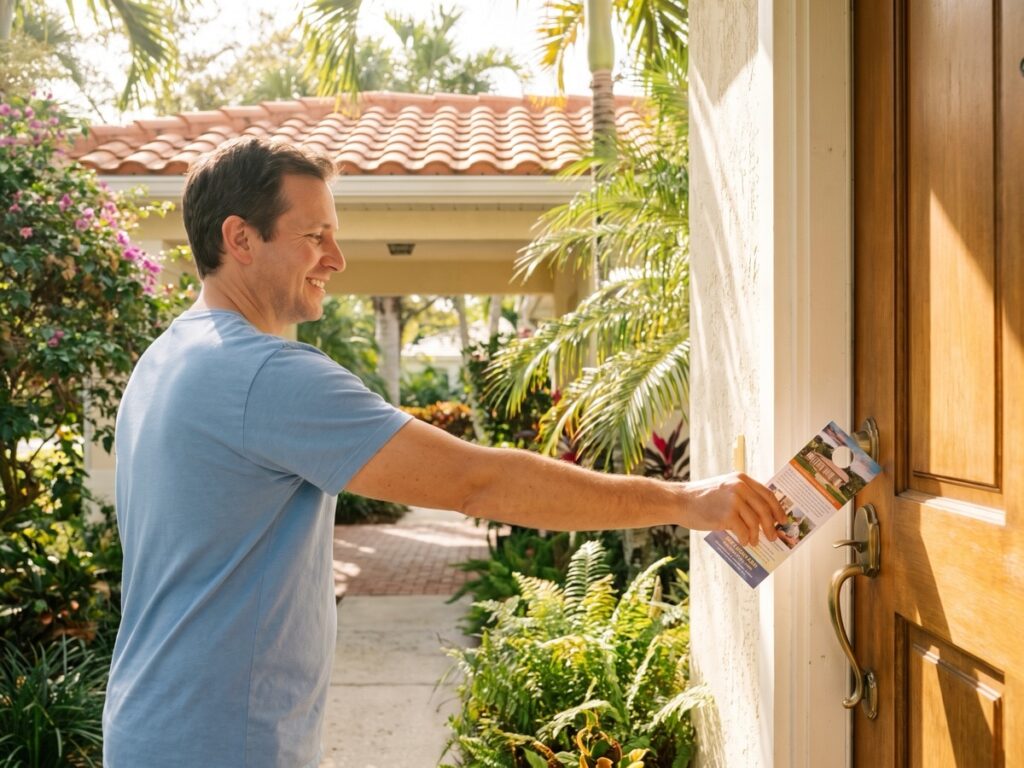
Home service businesses face a persistent challenge: reaching homeowners at the exact moment they need a solution. While digital ads compete for attention in crowded newsfeeds, a physical marketing piece placed directly on someone’s door creates an unavoidable touchpoint. This explains why savvy contractors have shifted significant portions of their marketing budgets toward tangible, neighborhood-level outreach.
The most successful home service contractors rely on dedicated strategies that put their brand directly in front of qualified prospects. Unlike mass-market approaches that waste resources on uninterested audiences, targeted physical marketing delivers messages to specific neighborhoods where services are most needed. This precision transforms marketing from a numbers game into a strategic operation.
This article examines why professional Door hanger delivery service solutions have become essential for contractors seeking predictable lead generation, how these services outperform traditional marketing channels, and what makes them particularly effective for local service businesses.
The Geographic Advantage of Hyperlocal Marketing
Home service contractors operate within defined service areas where travel time directly impacts profitability. A plumbing emergency three towns away costs more to service than one around the corner. This geographic reality makes neighborhood-specific marketing not just smart—it’s essential.
Door hangers allow contractors to saturate specific ZIP codes, subdivisions, or even individual streets. When a roofing company completes a job, they can blanket the surrounding 200 homes within days. Neighbors notice the work truck, see the new roof going up, then find detailed information on their door that evening. This timing creates a psychological connection between observed quality work and available service.
The hyperlocal approach also builds brand density. When multiple households in the same neighborhood receive the same message, it creates a perception of market dominance. Homeowners assume a contractor must be established and trustworthy if they’re investing heavily in the area. This social proof operates at a subconscious level but influences decision-making when service needs arise.
Why Physical Marketing Outperforms Digital for Service Contractors
Digital advertising platforms promise precise targeting and measurable results. Yet home service contractors consistently report stronger ROI from physical marketing pieces. The reason lies in how homeowners make service decisions.
Most home service needs are reactive, not proactive. A water heater fails, a garage door breaks, or storm damage requires immediate attention. In these moments, homeowners don’t scroll through social media ads or conduct extensive Google searches. They look for the most convenient, trustworthy option available right now.
A door hanger placed last week sits on the kitchen counter, stuck to the refrigerator, or filed in a drawer. When crisis strikes, it’s physically present—no search required. This availability at the moment of need converts prospects into customers at rates digital remarketing campaigns struggle to match.
Physical marketing also bypasses the trust deficit plaguing digital spaces. Homeowners have grown skeptical of online reviews, sponsored search results, and social media ads. A professionally designed door hanger represents tangible investment. It signals a real business with staying power, not a fly-by-night operation with a website and PO box.
The Professional Distribution Difference
Many contractors attempt door hanger campaigns by assigning the task to crew members between jobs or hiring neighborhood teenagers. These amateur approaches consistently underperform and damage brand perception.
Professional distribution services employ trained teams who understand the nuances of effective delivery. They know which days and times maximize visibility, how to handle gated communities, and how to document coverage for accountability. They carry proper insurance and follow local solicitation ordinances that vary by municipality.
Quality Control and Verification
Dedicated services provide GPS tracking and photographic proof of delivery. Contractors receive detailed reports showing exactly which addresses received materials and when. This transparency eliminates the uncertainty inherent in amateur distribution where hangers end up in dumpsters or never leave the truck.
Strategic Timing and Frequency
Professional services coordinate delivery schedules around weather patterns, local events, and seasonal service demands. HVAC contractors hit neighborhoods before summer heat waves. Landscapers saturate areas in early spring. This strategic timing ensures messages arrive when homeowner attention is highest.
Cost Efficiency and Scalability
The economics of professional Flyer distribution favor contractors who value their time appropriately. A plumber billing $150 per hour loses money personally delivering door hangers. Even paying crew members $25 per hour for distribution creates opportunity costs—those hours could generate revenue on job sites.
Professional services achieve economies of scale impossible for individual contractors. They optimize routes, batch deliveries across multiple clients, and employ distribution specialists who can cover neighborhoods in a fraction of the time amateurs require. The per-piece cost often matches or beats the true cost of self-distribution when all factors are considered.
Scalability represents another crucial advantage. A contractor experiencing rapid growth can expand their door hanger coverage from 500 homes weekly to 5,000 without hiring additional staff or diverting operational resources. This flexibility allows marketing to scale proportionally with business capacity.
Measurable Results and Attribution
Modern door hanger campaigns incorporate tracking mechanisms that provide clear attribution. Unique phone numbers, QR codes, and promotional codes allow contractors to measure response rates with precision. These metrics inform future campaign adjustments and justify marketing expenditures.
Contractors typically see response rates between 0.5% and 2% for door hanger campaigns—seemingly modest until you calculate the math. A 1% response rate on 10,000 hangers yields 100 inquiries. If the contractor closes 30% at an average job value of $800, that’s $24,000 in revenue. With professional distribution costing $500-$800 for that volume, the ROI becomes compelling.
These results compound over time. Door hangers create brand awareness even among non-responders. When future needs arise, that repeated exposure influences vendor selection. Contractors report that customers often mention seeing their door hangers multiple times before finally calling.
Building Long-Term Market Presence
Consistent door hanger campaigns establish territorial dominance. Contractors who maintain regular distribution schedules become the default option in their service areas. This top-of-mind awareness proves particularly valuable in emergency situations where homeowners need immediate solutions.
The cumulative effect of sustained physical marketing creates barriers to entry for competitors. A new contractor entering a market where an established player has been distributing door hangers monthly for years faces an uphill battle. The incumbent has already claimed mental real estate with thousands of homeowners.
Frequently Asked Questions
How often should contractors distribute door hangers in the same area?
Most successful contractors follow a quarterly distribution schedule in their core service areas, with monthly campaigns in high-value neighborhoods. This frequency maintains visibility without creating negative oversaturation. Seasonal businesses may concentrate efforts in the months preceding peak demand.
What response rate should contractors expect from door hanger campaigns?
Industry benchmarks suggest 0.5% to 2% response rates for well-designed door hangers distributed in targeted areas. Higher-end services and emergency offerings typically see rates toward the upper range. Response rates improve with repeated exposure to the same neighborhoods over time.
How do door hangers compare to direct mail in effectiveness?
Door hangers outperform direct mail for home service contractors by 2-3x in most markets. The physical placement on the door creates higher visibility than mailbox materials that compete with bills and junk mail. Door hangers also avoid the “throw away unopened” reflex many homeowners have developed toward envelopes.
Can contractors target specific home types or demographics with door hangers?
Professional distribution services can target by property value, home age, neighborhood type, and other demographic factors. This precision ensures HVAC contractors reach homes with older systems, roofers target properties with aging shingles, and luxury service providers focus on high-value addresses.
What design elements make door hangers most effective for contractors?
Effective door hangers feature bold headlines addressing specific pain points, clear service descriptions, prominent contact information, and compelling offers or guarantees. Professional photography of completed work builds credibility. Including customer testimonials and industry certifications increases trust and response rates.
How do weather conditions affect door hanger distribution effectiveness?
Moderate weather conditions optimize door hanger campaigns. Extreme heat, cold, or precipitation reduces homeowner door traffic and can damage materials. Professional services monitor forecasts and adjust schedules accordingly. They also use weather-resistant materials that withstand typical environmental exposure.
Conclusion
The shift toward dedicated door hanger delivery services reflects a broader recognition among home service contractors: marketing effectiveness matters more than marketing volume. While digital channels create noise and competition, physical neighborhood marketing creates presence and authority. The contractors who dominate their local markets understand that being physically present in their service areas—through consistent, professional door hanger distribution—builds the trust and visibility that convert homeowners into loyal customers.
As digital advertising costs continue rising and effectiveness declines, the tangible impact of door hangers becomes increasingly attractive. Contractors who establish systematic distribution programs today position themselves as the default choice tomorrow, building market share one neighborhood at a time through proven, measurable physical marketing.