

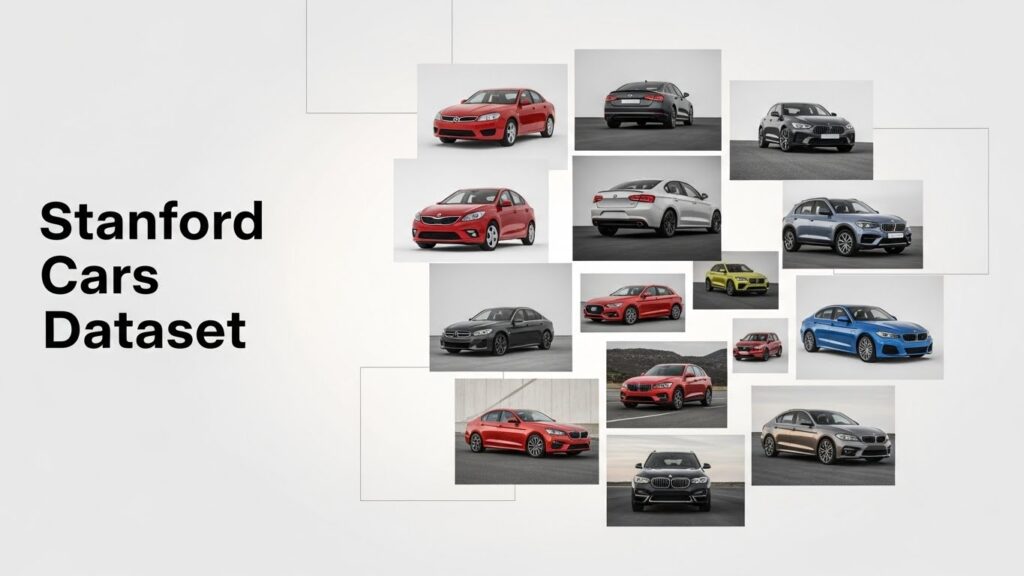
Introduction to the Stanford Cars Dataset
In the world of computer vision and machine learning, one dataset that stands out for car classification tasks is the Stanford Cars Dataset. Developed by the Stanford AI Lab, this dataset is a powerful resource for training and testing models to recognize car types and make. With over 16,000 images of cars, it has been used by researchers and developers to create cutting-edge image classification systems. In this article, we will take an in-depth look at the Stanford Cars Dataset, its key features, applications, and how to use it effectively for machine learning projects.
What is the Stanford Cars Dataset?
The Stanford Cars Dataset is a collection of images designed to train and evaluate computer vision models in the task of fine-grained car classification. Unlike general image recognition datasets, it focuses on recognizing specific car makes and models, which requires higher precision. The dataset contains images of 196 car types, from make to model, making it one of the most detailed car classification datasets available.
Each car image in the dataset is labeled with the car’s make, model, and year, making it an invaluable resource for deep learning and automated image recognition. Researchers and developers use it to create models that can automatically classify vehicles in various contexts, from security surveillance to autonomous driving.
Purpose of the Stanford Cars Dataset
The primary purpose of the Stanford Cars Dataset is to advance research in computer vision and machine learning. More specifically, it serves the following purposes:
-
Car Classification: It helps train models to identify and classify vehicles by make and model with high accuracy.
-
Image Recognition: The dataset is used to build automated image recognition systems, making it highly useful in autonomous driving, surveillance, and automotive industries.
-
Fine-Grained Visual Categorization: Unlike general object detection datasets, this dataset challenges models to differentiate between subtle variations in car models, thus pushing the envelope in fine-grained classification.
-
Benchmarking: It provides a benchmark dataset for evaluating the performance of machine learning models in real-world vehicle classification tasks.
By offering a comprehensive, diverse set of vehicle images, it provides an excellent base for developing models that can accurately recognize and classify cars.
Key Features of the Stanford Cars Dataset
The Stanford Cars Dataset comes with several key features that make it particularly useful for researchers and developers working in computer vision:
-
Large Dataset: The dataset includes 16,185 images of 196 car types, making it one of the largest vehicle classification datasets available.
-
Detailed Annotations: Each image is labeled with the make, model, and year of the car, offering detailed and highly specific annotations for each vehicle.
-
Variety of Conditions: The images are taken under various conditions, which include different lighting, angles, and backgrounds, making it more challenging and useful for real-world applications.
-
High-Resolution Images: The images are high quality and suitable for training deep learning models that require large amounts of data for feature extraction.
These features make it an ideal resource for building highly accurate and robust car classification models.
Structure and Composition of the Dataset
The Stanford Cars Dataset is divided into several key components that help organize the data efficiently:
-
Train/Test Split: The dataset is typically divided into train and test sets, with 8,144 images in the training set and 8,041 images in the test set.
-
Categories: There are 196 categories, each representing a unique car model and year. These categories are organized alphabetically for easy access.
-
Image Format: The images are provided in a JPEG format, making them easy to handle for training and testing purposes in most machine learning frameworks.
The structured nature of the dataset ensures that it can be used efficiently for training and evaluation, and the organization by car make and model is particularly helpful for fine-grained classification tasks.
How the Stanford Cars Dataset is Used in Machine Learning
The Stanford Cars Dataset is a go-to resource for training convolutional neural networks (CNNs) and other advanced deep learning models. Here’s how the dataset is typically used:
-
Data Preprocessing: The images are preprocessed for input into neural networks, including resizing and normalization. Sometimes, data augmentation techniques (such as rotation or flipping) are applied to increase the variety of images and avoid overfitting.
-
Model Training: The dataset is used to train models that can learn to identify key features of the cars—such as body shape, wheels, and brand identifiers—in order to classify them correctly.
-
Evaluation: After training, the model is tested using the test set to evaluate its accuracy, precision, recall, and other performance metrics.
These machine learning models are often used in applications that require real-time object recognition or vehicle detection, such as autonomous driving systems or traffic monitoring cameras.
Applications of the Stanford Cars Dataset
The Stanford Cars Dataset has numerous applications in various fields of technology, including:
-
Autonomous Vehicles: By training deep learning models on this dataset, self-driving cars can better recognize and classify different vehicle types in real-time.
-
Surveillance and Security: Automated systems for security cameras can use the dataset to recognize cars entering restricted areas or being involved in criminal activities.
-
Vehicle Identification: The dataset is used by law enforcement and agencies to match cars to make, model, and year for identification purposes.
-
Retail and Marketing: Car manufacturers and marketers can use the dataset to build recommendation systems based on vehicle types that customers are likely to purchase.
In essence, this dataset plays a critical role in image recognition systems and in enhancing the safety and efficiency of several industries.
Challenges in Using the Stanford Cars Dataset
While the Stanford Cars Dataset is incredibly powerful, there are a few challenges that come with working with it:
-
Fine-Grained Classification: The subtle differences between car models can make classification challenging. This is especially true when trying to distinguish between models that share similar features.
-
Bias Toward Common Models: The dataset contains more images of certain car models than others, which can cause biases during training.
-
Limited Data on Some Models: While the dataset contains a wide variety of cars, some models may have fewer images available, affecting the accuracy of models trained on these specific cars.
These challenges require advanced techniques and careful handling of the dataset, but they also present interesting problems for machine learning researchers to solve.
Data Preprocessing for the Stanford Cars Dataset
To get the most out of the Stanford Cars Dataset, data preprocessing is a critical step. Here’s a general overview of the preprocessing process:
-
Resizing Images: The images are resized to fit the input requirements of deep learning models, typically to a consistent width and height.
-
Normalizing: Pixel values are normalized, usually between 0 and 1, to help the model learn more efficiently.
-
Data Augmentation: Techniques like rotation, cropping, scaling, and flipping are used to increase the variability of the training data and prevent overfitting.
By preprocessing the data correctly, you can ensure that your model trains effectively and doesn’t overfit to the training data.
Tools for Working with the Stanford Cars Dataset
Several tools and libraries can be used to work with the Stanford Cars Dataset:
-
TensorFlow and Keras: These deep learning libraries are ideal for training neural networks on the dataset.
-
PyTorch: Another powerful framework for image recognition and deep learning, well-suited for the Stanford Cars Dataset.
-
OpenCV: For image manipulation and data augmentation, OpenCV can be extremely useful.
-
scikit-learn: For traditional machine learning models, scikit-learn offers a variety of tools to work with the dataset.
Using these tools, you can quickly get started on building and training your own models with the dataset.
Exploring the Stanford Cars Dataset: A Step-by-Step Guide
Here’s how you can start working with the Stanford Cars Dataset:
-
Download the Dataset: Access the dataset through the official Stanford website.
-
Preprocess the Data: Use Python libraries like OpenCV or Pillow to preprocess and augment the data.
-
Choose a Model: Select a deep learning model like ResNet or VGG16 for classification tasks.
-
Train the Model: Use your chosen framework (e.g., TensorFlow, Keras, or PyTorch) to train your model.
-
Evaluate the Model: Test your model on the test set and assess its performance using metrics like accuracy, precision, and recall.
By following these steps, you’ll be able to create a robust car classification model.
Evaluating Models on the Stanford Cars Dataset
Once your model is trained, it’s time to evaluate its performance. The evaluation process typically includes:
-
Testing: Use the test set to assess how well the model performs on unseen data.
-
Metrics: Evaluate the model using metrics such as accuracy, precision, recall, and F1 score.
-
Error Analysis: Review the cases where the model performs poorly to identify patterns and areas for improvement.
This evaluation will give you valuable insights into the model’s strengths and weaknesses.
Common Algorithms Used with the Stanford Cars Dataset
The Stanford Cars Dataset is typically used with the following machine learning algorithms:
-
Convolutional Neural Networks (CNNs): Ideal for image classification tasks.
-
Transfer Learning: Using pre-trained models like ResNet or Inception can help achieve better results with less training time.
-
Support Vector Machines (SVMs): For smaller datasets, SVMs can be used for classification.
-
K-Nearest Neighbors (KNN): Another classical algorithm for image classification tasks.
These algorithms are widely used in image recognition tasks and work well with the Stanford Cars Dataset.
Stanford Cars Dataset in Deep Learning and Computer Vision
The Stanford Cars Dataset is often used in deep learning and computer vision projects, particularly for fine-grained image recognition. In these fields, the dataset is invaluable for training models that can not only classify vehicles but also identify subtle differences between models of the same make. By leveraging advanced neural networks and computer vision techniques, the Stanford Cars Dataset enables the development of highly accurate systems for real-world applications like autonomous driving and vehicle tracking.
Conclusion
The Stanford Cars Dataset is a powerful tool for machine learning and computer vision researchers. Whether you’re building a vehicle recognition system, working with deep learning models, or exploring fine-grained classification, this dataset provides a rich set of images to train and test your models. By using this dataset effectively, you can contribute to innovations in autonomous vehicles, surveillance, and image recognition technologies.
FAQs
-
What is the Stanford Cars Dataset used for?
It’s primarily used for car classification and image recognition tasks in machine learning and computer vision. -
How many images are in the Stanford Cars Dataset?
The dataset contains 16,185 images across 196 car types. -
How can I use the Stanford Cars Dataset?
You can download the dataset and use it to train deep learning models for vehicle classification. -
What are the challenges when using the Stanford Cars Dataset?
Some challenges include fine-grained classification and data imbalance among car models. -
Where can I access the Stanford Cars Dataset?
The dataset is available for download from the Stanford University AI Lab website.